
Where Finance Meets Hospitality: Sheila Kyarisiima’s Next Act
By Kristen Oliveri
What happens when a career built around capital, investment and emerging markets meets the personal business of hospitality?
For Sheila Kyarisiima, the two worlds aren’t as far apart as they might seem.
Her career has moved fluidly between Wall Street, public policy and entrepreneurship. After beginning at Goldman Sachs, Kyarisiima went on to work with the Rwanda Development Board before founding NISK Capital, a boutique corporate finance and investment advisory firm focused on East and Central Africa. Through the firm, she has advised on billions of dollars raised for companies across six countries.
But her entrepreneurial story has continued to evolve.
As Founder and Chairperson of Spelman Estates Rwanda Limited, Kyarisiima is now behind The Pinnacle Kigali, an intimate nine-room boutique hotel and private members club set on 3.2 acres in Kigali. The property brings together many of the threads that have defined her career: investment, an understanding of the market, relationship-building and a belief in the potential of the region—but through an entirely different medium.
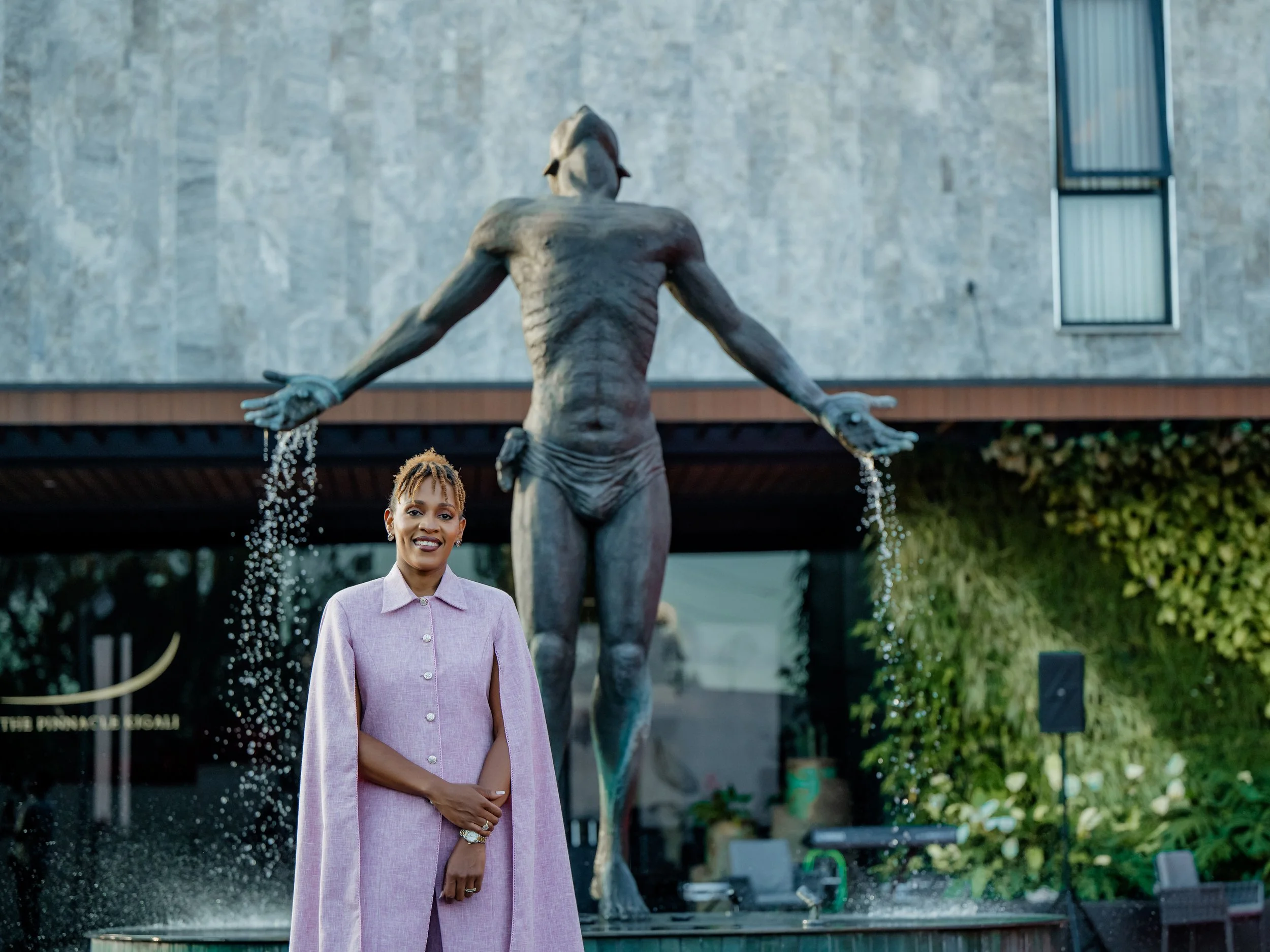
The result is hospitality that feels less about simply giving travelers somewhere to stay and more about creating a gateway into Rwanda. From individually designed rooms to experiences that stretch from Kigali to gorilla trekking, the Congo Nile Trail and Akagera, the property offers guests an introduction to the country rooted in a distinctly African point of view.
I sat down with Kyarisiima to talk about moving between finance and hospitality, building businesses in emerging markets and why her latest venture may be her most personal expression of entrepreneurship yet.
Q: Your journey has taken you from East Africa to Brown University, Harvard Business School and Harvard Kennedy School, through careers in civil engineering and at Goldman Sachs, before ultimately bringing you back home. What called you back to Rwanda when so many talented professionals choose to stay abroad?
A: It’s never an easy decision to choose a path that is less traveled, particularly when the alternative has all the markers of what would be considered more predictable and potentially safer. However, I ultimately chose to return home with a view that it was not about giving something up but about recognizing where I thought I could create a meaningful impact. Living and working abroad gave me an incredible education. I learned how world-class institutions operate, how businesses scale and how excellence is built intentionally. But it also made me appreciate something equally important: that the broader African continent and its people, have an extraordinary opportunity to shape their own future rather than simply participate in someone else's and I was excited to be a part of that story. I also felt a responsibility to bring back what I had learned and use it to build something meaningful, whether through creating jobs, developing talent, or building businesses in East Africa that could compete globally.
Q: Looking back, how did each chapter of your career prepare you to build something as ambitious as The Pinnacle?
A: Each stage taught me something different and together they formed the foundation for The Pinnacle. Engineering taught me systems thinking and how to solve complex problems methodically, understanding that every detail contributes to the integrity of the whole.
Goldman Sachs introduced me to the world of finance, investment and serving highly sophisticated clients. It taught me the importance of trust, discretion, execution and maintaining exceptionally high standards. This exposure contributed to my co-founding an East African boutique financial and transactions advisory firm; NISK Capital, that celebrated 11 years this July.
Brown and Harvard broadened my perspective and challenged me to think globally and greatly enriched my learning through the community of incredible peers with diverse backgrounds and experiences. They also reinforced that leadership isn't simply about expertise but about bringing people together around a shared vision.
Hospitality might seem like an entirely different field, but in many ways it's the intersection of all of those experiences. You're designing systems, managing capital, creating experiences, building teams and solving problems every single day. The Pinnacle demands that I tap into all those lessons collectively.
Q: The Pinnacle was originally envisioned as a private family home before evolving into Rwanda's most luxurious hotel and the country's first private members' club. What prompted that pivot, and what did it teach you about listening to both your vision and the market?
A: Initially, we intended for it to be a family retreat and designed it as such, with our personal story, individual tastes and interests reflected in the design. We wanted to create a place that both our family and friends could escape to, but that would also be a part of our legacy as a statement real estate piece showcasing the best of design and experiences rooted in a sense of home.
Ultimately, towards the end of the project, we realized that it was too beautiful to keep to ourselves and decided to share it with the world. Rwanda has increasingly become an attractive destination for global leaders, investors, entrepreneurs and discerning travelers.
In pivoting, my vision was to offer a hospitality experience that fully reflected the sophistication of modern Rwanda while remaining deeply rooted in its culture. As ardent travelers, we had experienced ultra luxury in other parts of the world and were convinced that we could create our own version of similar experiences back home. The more we listened to the conversations happening around us, the clearer it became that what we were building had the potential to serve a much bigger purpose.
This pivot has been a full immersion in an operationally complex industry that has deepened my entrepreneurial experience from what I’ve done before.
Q: Entrepreneurship often requires knowing when to hold your course and when to change direction. How do you personally decide when it's time to pivot?
A: I try to distinguish between changing the destination and changing the route. Our commitment to celebrating African luxury and creating an extraordinary guest experience has remained our destination. What constantly evolves is how we get there. I spend a lot of time listening to our guests, our team and the market. Data matters, but so does intuition. Sometimes repeated feedback reveals opportunities you couldn't have anticipated.
I triangulate between what the data and market feedback is telling me, and what my intuition and vision are asking of me. My pivots come from learning and how that intersects with my vision and intuition. I see that as part of my leadership responsibility.
Q: Developing a luxury brand in Africa comes with unique opportunities and challenges. What misconceptions or stigmas have you encountered, and how are you working to change that narrative?
A: One of the biggest misconceptions is a pre-determination of what luxury is or could be, and a hesitance to recognize African luxury brands and their value. For decades, luxury has largely been defined through European traditions and Africa has often been viewed primarily as a source of raw materials, culture, or inspiration rather than as a creator of globally respected luxury brands. We're working to challenge that narrative by demonstrating that excellence has no geography.
Luxury is defined by craftsmanship, authenticity, service, design and the ability to create meaningful experiences. At The Pinnacle, we're intentionally showcasing African creativity through architecture, art, design, cuisine and storytelling. Rather than importing an international luxury template, we're building something that could only exist in Rwanda.
Q: You've spoken about Africa's opportunity not just to host luxury brands, but to create and own them. What do you believe the continent's luxury industry could look like over the next decade if more entrepreneurs invest in building homegrown brands?
A: Across the continent, we're seeing entrepreneurs building exceptional brands in fashion, hospitality, design, wellness, food and technology. As more founders choose to create rather than simply consume luxury, we'll begin defining global standards rather than following existing ones. Africa has one of the world's youngest populations, extraordinary creative talent and rich cultural traditions. If we continue investing in quality, innovation and storytelling, I believe we'll see African luxury brands become globally recognized not because they're African, but because they're exceptional.
Q: What does African luxury look like through your eyes, and how is it different?
A: African luxury is about warmth, generosity, community, craftsmanship and a profound connection to place. It is about creating experiences that feel meaningful and memorable.
At The Pinnacle, luxury means waking up to views of Kigali, surrounded by African art, enjoying locally inspired cuisine, receiving intuitive service and feeling genuinely welcomed. African luxury has the opportunity to offer exactly that because every destination has stories, traditions, and perspectives that cannot be replicated elsewhere. African luxury feels familiar. Like a beloved auntie’s embrace or the smell of a much-missed meal. It feels like home.
Q: Returning home wasn't simply a career decision. It was an investment in your country's future. What impact do you hope The Pinnacle has on Rwanda beyond hospitality?
A: Hospitality is only one part of what we're building. We hope The Pinnacle contributes to Rwanda's broader economic and cultural development by creating meaningful employment, investing in local talent, supporting artists and craftspeople and strengthening Kigali's position as a global destination.
We're also creating spaces where ideas can flourish. Through our members' club, we're bringing together entrepreneurs, creatives, investors, diplomats and leaders from around the world. Those conversations often lead to collaborations that extend far beyond our walls.
Ultimately, I hope The Pinnacle becomes an ambassador for Rwanda, with every guest leaving with a deeper appreciation for the country and its people.
Q: You have spoken about inspiring the next generation, particularly women, to return home and build meaningful careers. What would you say to someone who feels pulled between opportunities abroad and creating something impactful in their own country?
A: I don't think it's an either-or decision. There is tremendous value in gaining international education and experience, and being our global representation. The question is how you ultimately use what you've learned.
For those who feel called to return home, don't underestimate the value of your perspective. Sometimes the combination of global exposure and local understanding allows you to see opportunities that others miss. Building something isn't always easy. It requires patience, resilience and optimism. But there's something incredibly fulfilling about contributing to the future of a place you care deeply about.
My advice would simply be to both ask yourself where your talents can create the greatest impact, and where you feel pulled to plant roots. That answer is different for everyone.
Q: Every founder has a superpower. What's yours, and how has it shaped your leadership style?
A: I think my superpower is resilience on steroids. And this extends beyond work. My husband always jokes that I must love pain. My approach and attitude is to dust off, and try again. This has been incredibly useful while operating in tough environments across my various entrepreneurial ventures. I never give up. I experiment and pivot countless times but I am relentless about finding what the right problem and its right answer is. I expect the same from my team. My mantra is “fail fast, and fail forward”, solve a new problem, tackle a new challenge, everyday. And accept when you’re wrong and take the lesson and keep charging forward.
Q: Success starts long before the workday begins. What does your morning ritual look like and are there any daily habits that help keep you grounded as a founder?
A: Hugs and kisses from my two young boys to start the day are a must. They remind me of what’s most important. I then start most mornings by breaking a sweat. I workout an average of 5 days a week. I enjoy padel, boxing and a mix of strength training and HIIT. That always centers me. I then like to spend some time with my thoughts, praying and meditating. Clearing my mind, trying to parse through what are the most critical things I must do for the day, week or month. This doesn’t always happen in the mornings, so sometimes it’s in the evenings, but it’s a cornerstone habit of mine. I’m also constantly trying to learn something new. Reading, audio books, podcasts, name it. And lastly, I generally have family rhythms that involve a certain number of meals shared together, weekend activities, travel experiences and just pausing amidst it all to center on family.
Q: As you look ahead, what excites you most about Rwanda's future on the global stage, not just as a destination, but as a place for innovation, entrepreneurship and luxury?
A: What excites me most is that Rwanda is increasingly being recognized not simply for what it has overcome, but for what it is creating. We're seeing innovation in technology, finance, sustainability, healthcare, education, tourism and entrepreneurship. I believe Rwanda has an opportunity to become a global benchmark for a more thoughtful kind of luxury, one rooted in authenticity, sustainability, cultural richness and genuine human connection.
More broadly, I hope Rwanda becomes known as a place where bold ideas are built and flourish. If The Pinnacle contributes even a small part to changing how the world sees Rwanda and how Africa defines luxury, then we'll have achieved something worth pursuing.