
Investing with Intention: Peter Krull on Values, Impact, and the Future of Sustainable Living
By Kristen Oliveri
As conversations around wealth evolve, more investors are looking beyond returns to consider the impact their capital has on the world. Peter Krull, Director of Sustainable Investing at Earth Equity Advisors, has spent more than two decades helping individuals and families align their portfolios with their values through sustainable and responsible investing. In his new book, The Sustainable Investor, he distills years of experience into a practical framework for making more intentional financial decisions while avoiding greenwashing.
In this conversation, Krull shares insights from the book, the evolution of sustainable investing and why the principles of conscious stewardship extend beyond portfolios, influencing how we live, spend and even travel.
Q: Your new book,The Sustainable Investor, distills decades of experience into an accessible framework. What inspired you to finally put these stories, lessons, and philosophies into a book? Was there a specific moment that made you say, “It’s time”?
A: Sustainable investing, and especially ESG (Environmental, Social, Governance) risk mitigation techniques, have become overwhelmingly politicized over the past several years. Legacy industries, such as coal and other fossil fuels launched active disinformation campaigns against ESG. They were concerned that their stock was being excluded from portfolios because of the high environmental material risks that the company’s operations pose. They passed their concerns onto sympathetic politicians who then amplified the disinformation using phrases like “woke investing” to undermine the progress that our industry has made.
I wanted to, as a thought leader and a 20+ year veteran of the sustainable investing industry, set the record straight. We cannot cede the pulpit to those who are choosing to spread disinformation without an equally strong voice to counter the rhetoric.
This book was an opportunity to add to my efforts to be that strong voice.
We now live in a changed climate world – I know this from experience living in Asheville, NC where Hurricane Helene devastated our community in September 2024. We cannot continue to do the same things that we’ve always done just because we’ve always done them that way. But fossil fuel companies, which are the crux of the problem, continue to resist change to a clean energy economy. They won’t stop until they’ve drilled for and mined every last dollar that’s under the ground – despite the consequences.
I was at a conference recently and heard a wonderful quote from Bishop Deon Johnson, the Episcopal Bishop of Missouri. He said “If you don’t like change, you’re going to like irrelevance even less.” This is why I do what I do. Change is the only constant, and investing in the future – a cleaner, more resource-efficient, more resilient, and more equitable economy is that future. That’s why I wrote the book.
Q: Can you walk us through your writing process? Did you approach the book like an educator, a storyteller, an investor, or a blend of all three? And how did you find your voice as an author in the sustainability space?
A: I started the book off rather ad hoc and quickly realized that I needed a plan. I had put together a rudimentary table of contents for the publisher, but I decided to spend some additional time developing that table which ultimately became my guide as I wrote.
I assembled tons of data and sources, some of which ended up in the book, and some that didn’t. I kept everything in a folder on my desktop, and as I came across something that was relevant, I added it. I also kept a separate browser window open with tabs for a lot of the more important sources.
I began by writing linearly – chapter 1, chapter 2, etc. But I quickly found out that it didn’t work for me and began jumping around writing about what I felt like writing at the moment. I was able to see linkages between subjects and also identify chapters that I hadn’t thought about. At one point I realized, “I don’t have a chapter on performance,” and quickly added it to the table of contents.
I wrote most of the initial chapters of the book while I was traveling for business. As I began to come down to the wire, however, I knew that I would need to cloister myself away. So, I headed out to our lake cabin and wrote for a few weeks and made great progress. Then Hurricane Helene hit. That was September and my manuscript was due in December. I reached out to my editor and asked for an extension which she gladly granted. I didn’t need the extension because I was running out of time. I wanted the extension because I wanted to integrate my experience and the insights that came along with living through the hurricane. I’m glad I did.
In general, I approached the book as an educator, like I said earlier, working to set the record straight. But I also know that people remember stories, so I tried to integrate as many stories as possible to make the narrative more real.
My degree is in communication, so I’ve been writing for a long time. I think my voice has been honed for the past twenty years in this business and, with the anti-ESG crowd continuing to get louder, my voice has amped up as well.
Q: Sustainable investing has become a buzzword, but your book aims to bring clarity and credibility to the conversation. What are three key takeaways that you hope every reader walks away with, regardless of their experience level?
A: The first thing I want people to realize is that values-based investing has been around for a long time – this isn’t something that came about recently. In fact, religious folks have been investing with a social conscience since the 17th century, avoiding sin stocks like tobacco, alcohol, and gambling.
We now have ways to quantify risks on companies. This is the second thing I want people to take away. ESG is about risk. Period. It’s about assessing material environmental risks, social risks, and governance risks ON a company. The media and politicians would have you believe that ESG is about the impact a company has on the world around it, but it’s just the opposite. ESG is a risk assessment technique that I like to call enhanced due diligence.
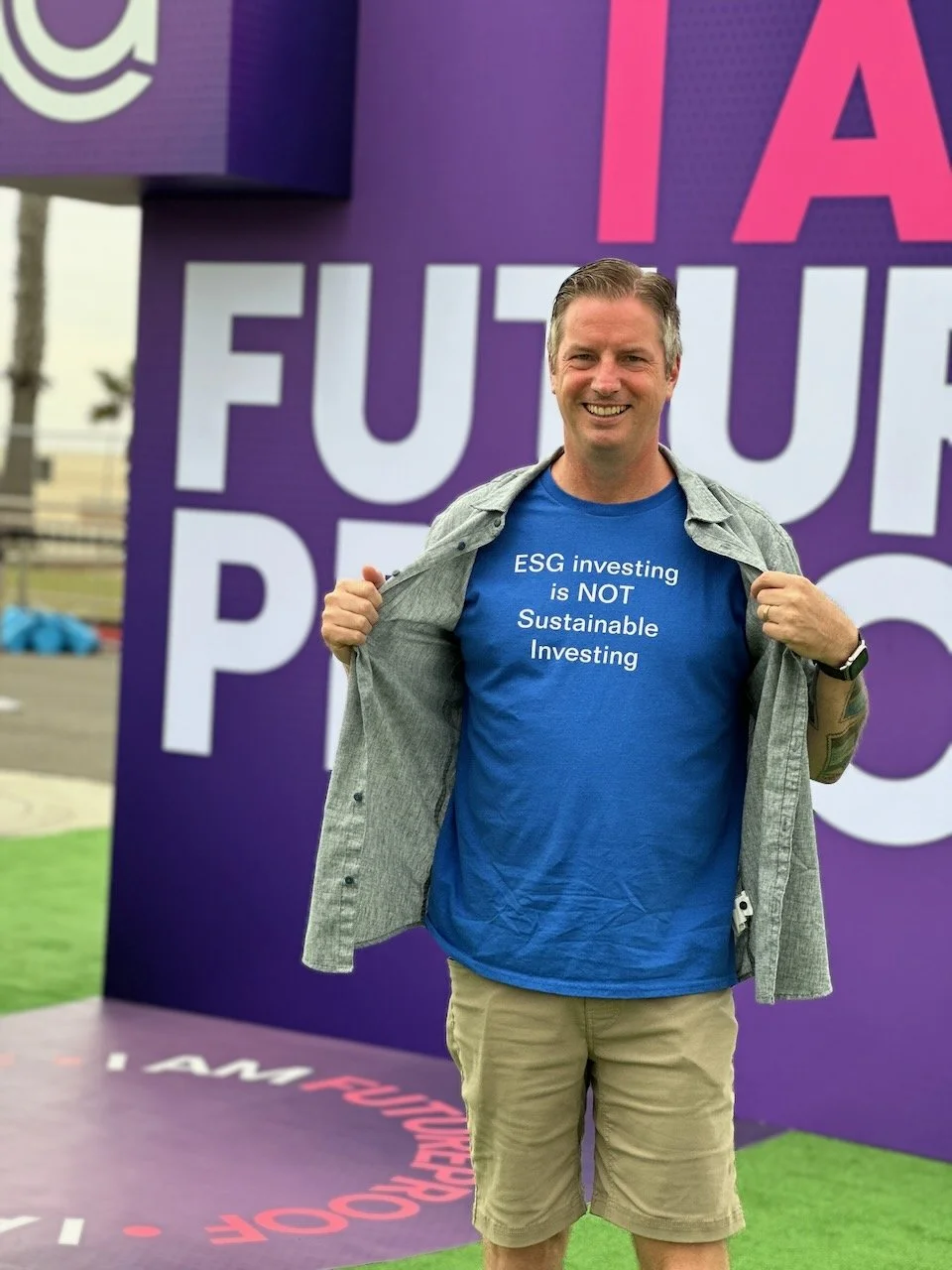
The final thing I’d like people to understand is that ESG is not sustainable investing – they’re different things. While ESG is a top-down risk management tool, sustainable investing is a bottom-up process to build a portfolio of solutions to our greatest challenges such as the changed climate. Can ESG metrics be used in a sustainable portfolio? Yes. But at the end of the day, they’re different things, and I prefer the solutions-oriented aspect of sustainable investing over a purely ESG, risk-management portfolio.
Q: You’ve often said that sustainability is not a trend, but a long-term shift in how business should operate. How does your book help investors distinguish between genuine sustainable practices and greenwashing?
A: Much of that distinction is about truly understanding the difference between ESG and sustainable investing as I outlined in the previous question. It’s much easier to greenwash an ESG portfolio, both in how the portfolio is constructed and how it’s communicated versus a bottom-up, solutions-based sustainable portfolio.
Many ESG managers use a “best in class” philosophy. With a philosophy like this, you could end up with what the manager considers the best fossil fuel company relative to its peers. But, of course, we know that fossil fuels are the cause of our current existential crisis, so including them would certainly be anything but sustainable, and greenwashing at best in an ESG portfolio.
In the book, I list out the industries and themes that we see as being vital to a sustainable economy – one that is cleaner, more resource efficient, more resilient, and more equitable. While this list is constantly evolving, it currently looks like this:
· Clean energy
· Energy efficiency
· Battery technologies
· Water distribution, filtration and efficiency
· Green Transportation
· Infrastructure – resilience and adaptation
· Natural and organic products and services
· Sustainable real estate
· Information technology, big date and IOT – efficiencies at scale
· Green finance, insurance and community investments
· Recycling and circular economy
· Green building technology
· Cutting edge biotechnology
· Organic and regenerative agriculture
All of these industries and themes represent where the economy needs to move over the next several decades in order to face our current challenges. We try to find those companies who we feel will be market leaders in each of these areas.
Q: In writingThe Sustainable Investor, what surprised you most, either in your research, your reflections or the way the themes came together?
A: I think the biggest surprise came after Hurricane Helene. I observed that in Asheville, we had a devastating failure of our utility infrastructure, our communications infrastructure, and our transportation infrastructure. We simply weren’t prepared for a storm of this magnitude, and most communities aren’t as well. Out of this realization came a thought that we need to redefine SRI. When I started in this business, SRI stood for socially responsible investing. Over the years, it changed to sustainable, resilient and impact investing. But in the wake of what I witnessed in Asheville, I realized that it needed to evolve again to mean sustainable, resilient, and innovation investing.
The resilience piece is key, as we barrel into a changed climate world, we need to prepare ourselves, not for the storm or fire or drought that we just had, but the more intense one that is on the horizon. Sustainability is still very important as we need to continue to reduce our emissions and impact, but it needs to be married to resilience. And innovation is what defines our generation. It’s going to be necessary if we’re to become more sustainable and more resilient and adaptive.
Q: You work at the intersection of values, purpose and financial planning. How do you hope your book influences advisors, families and even next-gen investors who are taking a more intentional approach to wealth creation?
A: Morgan Stanley’s most recent Sustainable Signals report shows that 99% of Gen Z, 97% of Millennials, and 86% of Gen X are somewhat or very interested in sustainable investing. My hope is that financial advisors and family offices recognize this interest and prepare themselves to service these NextGen clients. They have different attitudes, values, and goals than their parents and grandparents. They see both the risks of the changed climate, but also the opportunities to have a positive impact. And now, with so many new and interesting sustainable investment vehicles to serve these next generations, advisors don’t have an excuse to not offer them. All they need to do is take the time to educate themselves and work with the next generation. Otherwise, those clients are moving to advisors who understand their needs.
Q: What travel destinations inspire you and your wife the most, and how do those environments influence your perspective on sustainability and investing?
A: As you know, we love to travel! We used to spend quite a bit of time in Costa Rica, enjoying the tremendous biodiversity and warm weather during the gray, cold months in North Carolina.
I think our travels in Europe have probably been the most impactful from a sustainability perspective. Iceland, an absolutely beautiful country, by the way, is powered by almost 100% renewable energy: hydropower and geothermal. I remember driving through Germany and seeing solar panels on barns, houses, and businesses – everywhere. And Germany is as far north as Canada, so they don’t get as much sunshine as many other countries. Europe just seems to have an awareness that we don’t see here in the states about doing the right thing and working together with their neighbors to reduce their impact. All of our portfolios have a good sized allocation to international, and in particular, European investments.
Q: We love to end on a personal note: What would you say is your superpower: the quality that has propelled your career, your writing and your mission in sustainable investing?
A: My parents were in their mid-40s when they had me, so they were both part of the Greatest Generation. Even though neither of them had high school educations, they were able to provide a very comfortable childhood and education for me. They had an amazing work ethic.
I inherited their work ethic, and that’s been my superpower for the last few decades. Every day, putting one foot in front of the other. Making that call. Writing that article. Researching that fund or stock. Consistently doing something, no matter how small, every day to improve myself and the business.
It can be tiring, and sometimes you question what am I doing this for, but then, as has happened this week, you get a call from a contact you made 20 years ago, and another you made 10 years ago asking about investing, and realize that you’ve made an impact. We hosted our twenty-year Earth Equity anniversary party last year, and saw a hundred people come out to celebrate with us. It’s a lot of small acts that ultimately build up to a successful career and business – one step at a time.